Business Process Automation
Automate repetitive tasks, approvals, notifications, reporting, data entry, document handling, and administrative work so your team can spend more time on work that actually needs people.
Legacy Automations helps businesses of every size reduce repetitive work, connect the tools they already use, and build smarter AI-powered systems — from everyday workflows to secure enterprise automation and custom applications.
Business-first. Technically built to last. Google Cloud · Google Workspace · Microsoft 365 · AI & Agents · APIs · Custom Applications
Start With The Problem
You do not need to know whether your business needs an API, AI agent, workflow, cloud service, or custom application. Tell us what is slowing your team down, and we'll design the right solution.
Bring us the business problem. We handle the automation, AI, cloud, integrations, security, and engineering behind it.
Capabilities
Whether you need one repetitive task automated or a secure system that supports an entire organization, we combine practical business outcomes with production-ready engineering.
Automate repetitive tasks, approvals, notifications, reporting, data entry, document handling, and administrative work so your team can spend more time on work that actually needs people.
Give employees or customers AI tools that can answer questions, understand company information, find the right documents, assist with decisions, and help complete real business tasks.
Make Google Workspace, Microsoft 365, Google Cloud, and your other business systems work together automatically — including provisioning, permissions, files, email, and integrations.
Need something your current software cannot do? We build custom internal tools, portals, workflow applications, and AI-enabled systems around the way your business actually operates.
Approach
We start with how the work happens today, then design, build, test, and document a solution your business can actually rely on long-term.
01 · Map the messy reality
We start with the actual process: emails, spreadsheets, forms, screenshots, handoffs, and the way work really flows through your business today.
02 · Design the governed future
Together we design the better process, define exceptions, access rules, integrations, and documentation requirements — before anything moves into production.
Sample Use Cases
Some businesses need a simple workflow. Others need AI, cloud infrastructure, custom applications, or enterprise governance. These examples show the range.
01
Instead of managers emailing spreadsheets and someone manually combining them, budget data is collected, validated, analyzed, and turned into forecasts automatically. Leadership receives an executive-ready summary without the usual spreadsheet chase.
02
Employees can ask a company-specific AI assistant questions about policies, procedures, files, or internal tools. With the right permissions, it can also help complete tasks such as access requests, provisioning, or report generation.
03
Route changes, incidents, service requests, or field updates can automatically notify the right people, update schedules, capture information, and keep operations moving without repeated calls, texts, or manual updates.
04
Keep groups, shared drives, sites, and permissions organized automatically with ownership checks, scheduled access reviews, alerts for risky changes, and recurring cleanup tasks.
Insights
Deep dives on governed AI, automation architecture, and the operational patterns that actually scale inside real organizations.
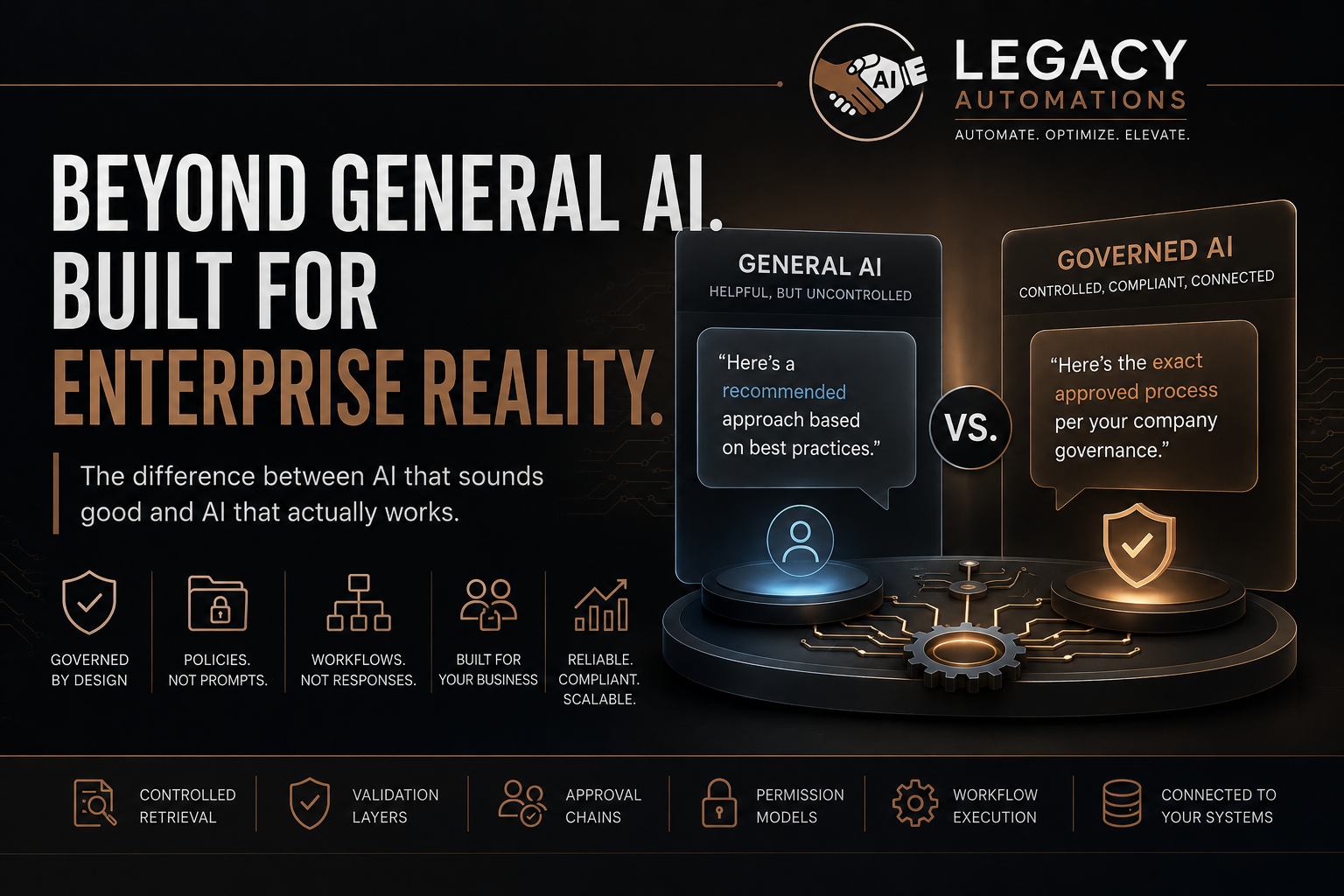
Governed AI
The difference between AI that sounds good and AI that actually works inside your org. We break down controlled retrieval, validation layers, approval chains, and permission models — the architecture that separates governed AI from a fancy chatbot.
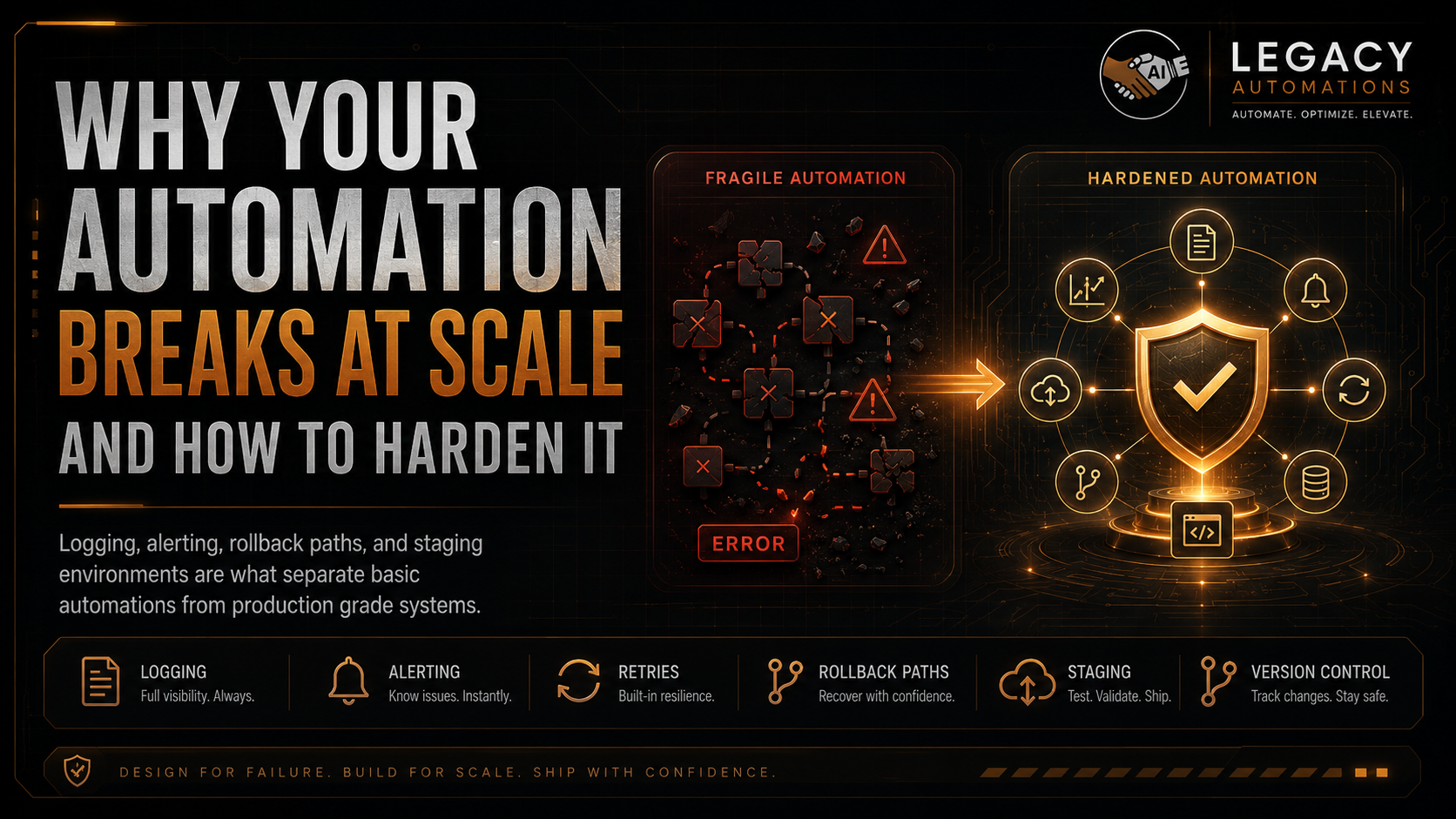
Automation Engineering
Logging, alerting, rollback paths, staging environments, and governance separate basic workflows from production grade automation systems.
RAG & AI Assistants
How retrieval-augmented generation, access controls, and human-in-the-loop design turn a generic LLM into an org-specific intelligence layer.
Ops Intelligence
The discovery and mapping process we use to translate messy, undocumented operations into structured, observable automation systems.
Let's Build
You do not need to know what technology you need. Tell us what your team does manually, where work gets stuck, or what you wish your systems could do. We'll help map the right path forward.
Send a quick snapshot of your business, the tools you use, and the work you want to improve. We'll use the first conversation to understand the problem and identify practical automation, AI, cloud, or custom-development options.